

Shiv Shakti Team
Digital Experts
AI Agents vs Traditional Marketing Automation: Which One Is Better?
Marketing technologies have developed drastically over the past decade. Companies no longer depend solely on scheduled email sequences or workflows that connect with customers. Thanks to the swift development of AI technologies, AI agents are changing the way in which businesses handle marketing, communication, lead generation, and decision making.
Classic marketing automation software assisted companies in saving time through the automation of routine actions. Nevertheless, the modern AI agent does more than simply automate things; it analyzes information, makes decisions, personalizes experiences for customers, and improves campaign effectiveness independently.
Which tool is better for your company then?
In this guide, we will thoroughly compare AI agents with classic marketing automation tools, discuss their pros and cons and find out what solution works best for business development.
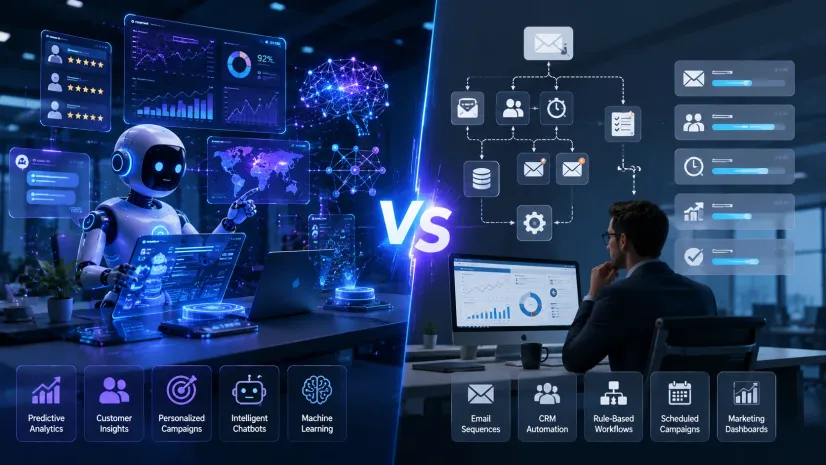
What Are AI Agents?
Definition of AI Agents: They are intelligent software programs which can understand the information and make decisions, learn from the available information and perform tasks independently without human assistance.
Unlike traditional automation processes which just follow predefined paths, AI Agents are dynamic in nature, understand the customers' intent and optimize their actions accordingly.
An AI Agent can:
- Analyze customer behavior
- Personalize marketing campaigns
- Generate content
- Qualify leads
- Respond to customer inquiries
- Schedule follow-ups
- Connect multiple business applications
- Learn from previous interactions
Instead of simply executing instructions, AI Agents continuously improve their performance using machine learning and advanced language models.
What Is Traditional Marketing Automation?
Traditional marketing automation refers to software that automates repetitive marketing activities based on predefined rules and workflows.
Businesses commonly use these platforms for:
- Email campaigns
- Lead nurturing
- SMS marketing
- Customer segmentation
- Landing page automation
- CRM updates
- Campaign scheduling
- Social media publishing
The system performs exactly what users configure. If conditions change unexpectedly, human intervention is usually required to update workflows.
Traditional automation is excellent for repetitive, predictable processes but lacks true intelligence.

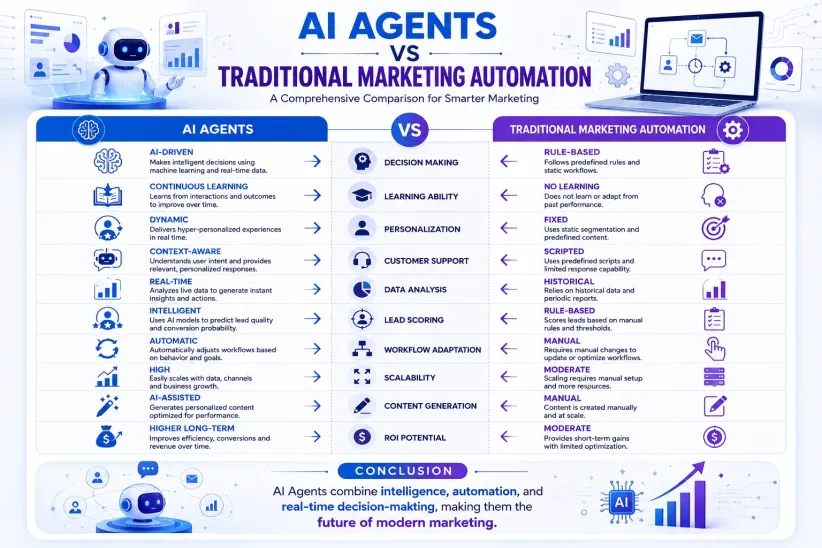
AI Agents vs Traditional Marketing Automation: Quick Comparison
| Feature | AI Agents | Traditional Marketing Automation |
|---|---|---|
| Decision Making | Intelligent | Rule-Based |
| Learning Ability | Continuously Learns | No Learning |
| Personalization | Highly Dynamic | Limited |
| Customer Understanding | Context-Aware | Rule-Based |
| Data Analysis | Real-Time | Historical Reports |
| Workflow Adaptation | Automatic | Manual |
| Content Creation | AI Generated | Human Created |
| Lead Qualification | Intelligent | Fixed Rules |
| Customer Support | Conversational | Automated Responses |
| Scalability | Very High | Moderate |
How Traditional Marketing Automation Works?
Traditional automation follows a "trigger → action" model.
Example workflow:
- Visitor downloads an eBook.
- The system sends Welcome Email.
- Waits three days.
- Send another email.
- If a user clicks, assign a lead score.
- Notify the sales representative.
The workflow is predictable because every action is manually designed beforehand.
This approach works well for structured marketing campaigns where customer behavior is relatively predictable.
How AI Agents Work Differently?
AI Agents don't rely only on predefined workflows. Instead, they:
- Understand customer intent
- Analyze conversation history
- Evaluate previous purchases
- Detect customer sentiment
- Recommend personalized offers
- Choose the best communication channel
- Decide the best time to engage
For example: A customer visits your pricing page three times, watches a product demo, reads two case studies, and asks a pricing question through chat.
Instead of waiting for a manual workflow, an AI Agent can:
- Identify purchase intent
- Answer questions instantly
- Recommend the most suitable plan
- Schedule a sales meeting
- Notify the sales team
- Continue follow-up automatically
All without human intervention.

Major Advantages of AI Agents
1. Real-Time Decision Making
AI Agents analyze customer behavior instantly and respond based on current context instead of outdated rules. This creates faster and more relevant customer interactions.
2. Hyper-Personalized Customer Experiences
Modern customers expect personalized communication. AI Agents can customize: Emails, Product recommendations, Website content, Chat responses, Discounts, Marketing offers. Each interaction becomes unique to the individual customer.
3. Continuous Learning
Unlike traditional automation, AI Agents improve over time. You can start building AI agents and grow. Every customer interaction helps the system make better recommendations, predict customer needs, and optimize future campaigns.
4. Intelligent Lead Scoring
Rather than assigning points based only on clicks or downloads, AI Agents evaluate: Website behavior, Buying intent, Engagement history, Customer conversations, Purchase probability. This helps sales teams prioritize high-quality leads.
5. Cross-Platform Automation
AI Agents can integrate with: CRM systems, Email platforms, Analytics tools, Customer support software, Project management platforms, Marketing dashboards. This creates a unified business automation ecosystem.
Where Traditional Marketing Automation Still Excels?
Despite AI's capabilities, traditional automation remains valuable. It is ideal for:
Simple Email Campaigns
Weekly newsletters and promotional emails don't always require AI.
Fixed Business Processes
Processes like Welcome emails, Appointment reminders, Invoice notifications, Birthday messages are easily handled using rule-based automation.
Lower Initial Investment
Traditional marketing automation platforms are generally less expensive and easier to implement for small businesses.
Easier Compliance
Since workflows are predefined, businesses often find it easier to maintain regulatory compliance and auditing requirements.
Real Business Example
Imagine two eCommerce businesses selling the same products.
Business A (Traditional Automation)
Customer abandons a shopping cart. System sends:
- Email after 1 hour
- Reminder after 24 hours
- Final discount after 48 hours
Every customer receives the same sequence.
Business B (AI Agent)
The AI Agent analyzes:
- Customer purchase history
- Budget
- Browsing behavior
- Product interests
- Time spent on pages
- Previous conversations
It may:
- Offer a personalized discount
- Recommend complementary products
- Answer product questions instantly
- Send messages through the customer's preferred channel
- Delay or accelerate follow-ups based on engagement
This creates a significantly more personalized shopping experience.
Cost Comparison
| Factor | AI Agents | Traditional Automation |
|---|---|---|
| Initial Setup | Medium to High | Low |
| Maintenance | Low | Moderate |
| Scalability | Excellent | Good |
| Manual Work | Very Low | Moderate |
| ROI Potential | Higher | Moderate |
| Long-Term Value | Excellent | Good |
Although AI Agents may require higher initial investment, many businesses see greater long-term returns through improved efficiency, personalization, and conversion rates.
Industries Benefiting Most from AI Agents
Healthcare, Finance, SaaS, Retail, Manufacturing, Real Estate, Education, Logistics, Digital Marketing, Customer Support, Travel, Insurance.
Businesses handling large volumes of customer interactions and data can gain significant advantages from AI-driven automation.
The Shift from Automation to Autonomous Marketing
One of the biggest changes in 2026 isn't just automation, it's autonomous marketing.
Traditional tools execute workflows that marketers design. A complete guide of AI Agents, however, can assist in planning, testing, and optimizing campaigns by:
- Identifying high-performing audience segments.
- Suggesting budget reallocations based on campaign performance.
- Recommending content variations for different customer personas.
- Detecting unusual changes in engagement before they become major issues.
- Providing actionable insights from large datasets in minutes.
This shift allows marketing teams to spend less time on repetitive operational tasks and more time on creative strategy, brand building, and customer relationships.
Challenges of AI Agents
Businesses should also consider these challenges:
- Higher implementation complexity
- Initial setup costs
- Need for quality data
- AI governance and oversight
- Employee training requirements
- Data privacy considerations
- Integration with legacy systems
The most effective approach is to combine AI capabilities with human expertise rather than relying on automation alone.
Which One Should You Choose?
Choose Traditional Marketing Automation if you:
- Have a limited budget.
- Need to automate repetitive marketing tasks.
- Run straightforward email or CRM workflows.
- Want quick implementation with minimal complexity.
Choose AI Agents if you:
- Need advanced personalization.
- Manage large customer datasets.
- Want intelligent decision-making.
- Aim to scale marketing operations efficiently.
- Seek to improve customer experience and lead quality.
- Plan to stay competitive as AI adoption grows.
Many organizations find the best results by using traditional automation for structured, repetitive processes while incorporating AI Agents for decision support, personalization, and customer engagement.
Future of Marketing Automation
As AI technology continues to evolve, marketing automation is expected to become increasingly intelligent. Future AI Agents will likely:
- Predict customer needs with greater accuracy.
- Coordinate across multiple marketing channels automatically.
- Generate more personalized content on websites at scale.
- Improve campaign optimization using real-time performance signals.
- Support marketers with strategic recommendations rather than only executing tasks.
Businesses that begin adopting AI thoughtfully today will be better positioned to adapt to these changes.
Conclusion
Marketing automation has been instrumental in making repetitive marketing activities easier for companies. Marketing automation is still an excellent tool for workflow and communication that has structure.
AI Agents have emerged as the next step in business automation because of their ability to make smart decisions, learn continuously, personalize in real-time, and analyze things intelligently.
While there may be a perception that AI Agents are alternatives to marketing automation technologies, companies would be better off looking at how both solutions can complement their objectives. The best scenario for many enterprises would be to adopt a combination of rule-based automation where possible and AI Agents when intelligence makes sense.
In a world where consumer demands keep getting higher, investing in intelligent automation becomes more important than ever before.
Read More Blogs
AI Agents vs Traditional Marketing Automation: Which One Is Better?
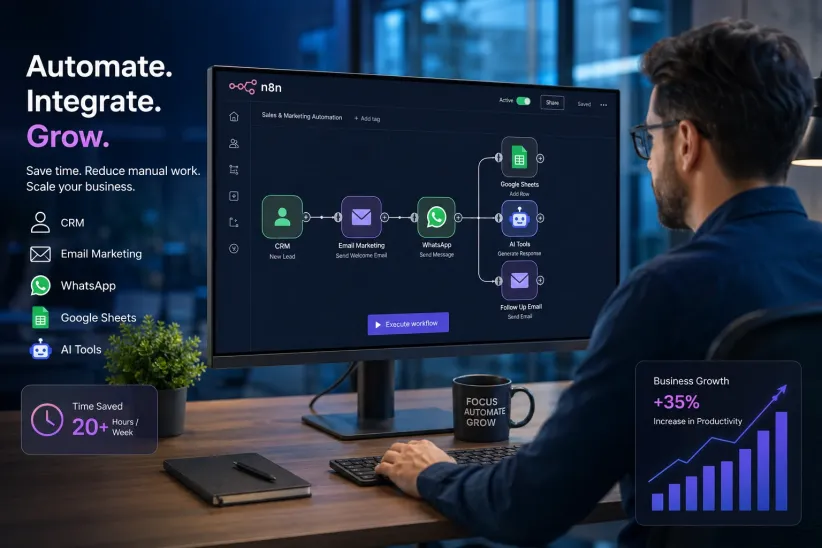
How n8n Automation Helps Small Businesses Save Time and Automate Repetitive Tasks?
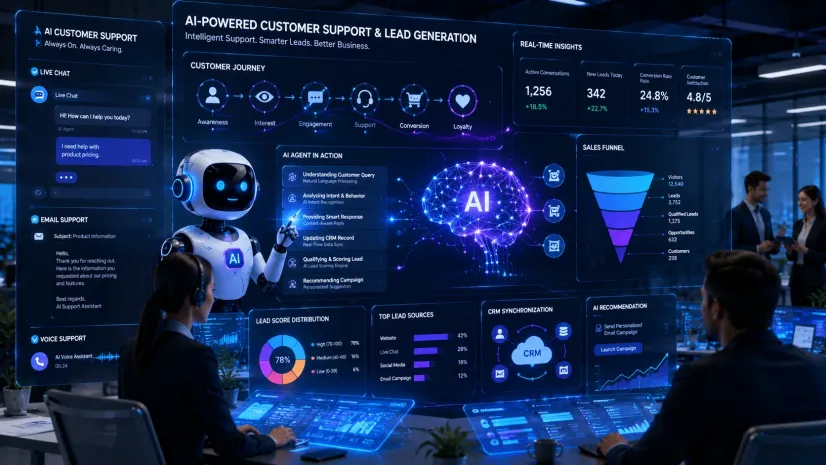
How AI Can Improve Customer Support and Lead Generation?
Frequently Asked Questions (FAQs)
Q.1 What is the difference between the AI Agents and conventional marketing automation?
Conventional marketing automation works on a pre-defined set of rules, whereas AI agents work by analyzing data and making smart decisions.
Q.2 Is there a possibility that AI Agents might replace traditional marketing automation?
No, not necessarily. The AI agents do supplement the traditional marketing automation systems by bringing an intelligent layer into the equation.
Q.3 Are AI Agents useful for small business owners?
Yes. AI Agents can be employed by small business owners in their customer service needs, lead generation, writing and marketing optimizations. Cloud based AI applications make access easier than ever before.
Q.4 Is there still a need for traditional marketing automation?
Yes. Marketing automation is highly efficient in completing routine and predictable tasks.
Q.5 Which solution offers a better ROI?
It is all about the business objectives. The conventional automation usually proves to offer higher ROIs when it comes to simplistic workflow, whereas the AI Agents may offer more value in the long run due to increased personalization and efficiency.
Shiv Shakti Softech
We are a team of passionate digital experts dedicated to helping businesses grow online through innovative web design, SEO, and marketing strategies.
Work with usNeed Expert Help?
Ready to leverage these strategies for your business? Let's talk about your project.
GET IN TOUCH