

Shiv Shakti Team
Digital Experts
What Is Edge Computing and Why Does It Matters?
With the amount of data being created increasing every day by businesses, using only cloud servers will not be adequate for many applications that require fast responses. Whether it is autonomous cars, smart factories, medical devices, or even retailers, businesses are now in need of fast processing, low latency, and reliability. Edge computing helps achieve all of that and more.
Unlike cloud servers which collect data from everywhere, edge computing analyzes the information close to where the data originates, either on the devices or close-by servers. As a result, businesses can benefit in terms of faster decision-making, lower bandwidth consumption, better security, and enhanced customer experience.
The latest web development in technologies such as Artificial Intelligence, Industrial IoT, 5G networks, and smart devices have helped speed up the process of adopting edge computing. Any business that adopts this technology will be at an advantage due to greater efficiency and real-time decision making.
This guide will help you understand the concept, how it works, its benefits, applications, and reasons for its growing popularity.
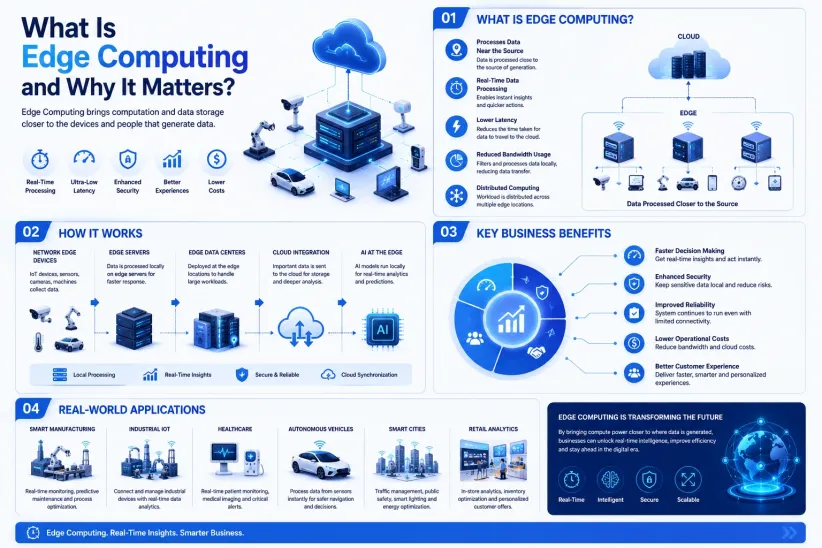
What Is Edge Computing?
This technology is a form of distributed computing that involves carrying out computations in close proximity to where the information is generated, rather than sending everything to a central cloud or data centers.
A good example is a security camera with an AI component that can do local processing on the video feed and not have to send huge volumes of video data up to the cloud all the time.
Only significant events or data summaries go to the cloud servers.
How Edge Computing Works?
A typical modern computing architecture environment consists of three primary components:
1. Edge Devices
These include:
- Smart sensors
- CCTV cameras
- Smartphones
- Industrial machines
- Connected vehicles
- Medical equipment
These network edge devices generate data continuously.
2. Edge Servers
Instead of transferring all data to remote cloud platforms, nearby edge data centers or local edge servers process the information instantly.
These servers filter unnecessary data while sending only valuable insights to cloud platforms.
3. Cloud Infrastructure
Cloud computing still plays an important role by handling:
- Long-term storage
- Advanced analytics
- Machine learning model training
- Centralized monitoring
- Business reporting
Rather than replacing cloud computing, edge computing complements it by creating a balanced and efficient architecture.
Why Edge Computing Matters?
Companies rely more and more on applications which require prompt reaction.
Even a small delay of several hundred milliseconds in cloud computing may influence users' experience and efficiency.
The following problems can be solved with edge computing:
- Higher speed
- Less latency
- Greater reliability
- Lower network congestion
- Increased security
It may have a great impact whether it is an industrial robot diagnosing equipment malfunction or an autonomous car recognizing an obstacle.
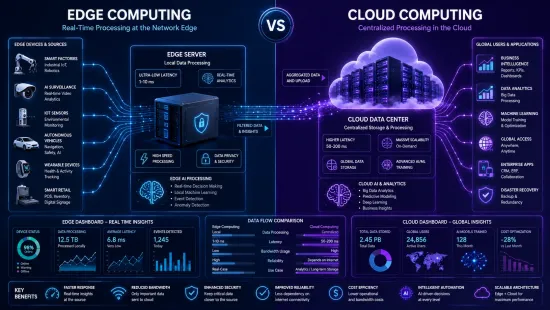
Lower Latency Improves Performance
One of the biggest reasons organizations adopt this technology is to reduce latency.
Latency refers to the time it takes for data to travel between devices and servers.
By processing data closer to users, businesses experience:
- Instant application responses
- Faster video streaming
- Improved gaming performance
- Better industrial automation
- Enhanced customer satisfaction
Low latency is especially critical for AI applications, healthcare systems, financial services, and autonomous technologies.
Improved Security and Privacy
Transferring massive amounts of sensitive information across networks increases cybersecurity risks.
Edge computing helps reduce these risks because:
- More data remains on local devices.
- Sensitive information is processed locally.
- Fewer data transfers reduce exposure.
- Businesses gain better compliance with privacy regulations.
Although cloud security remains important, combining cloud and edge security creates stronger overall protection.
Key Edge Computing Benefits
Organizations across industries are adopting this edge solutions because of its numerous advantages.
Faster Real-Time Decision Making
Businesses can analyze data immediately instead of waiting for cloud servers.
Examples include:
- AI-powered quality inspection in manufacturing
- Fraud detection in financial transactions
- Smart traffic management
- Industrial equipment monitoring
This capability makes AI at the edge increasingly valuable for organizations requiring instant intelligence.
Reduced Bandwidth Costs
Cloud storage and continuous data transmission can become expensive.
It minimizes these costs by:
- Filtering unnecessary data
- Compressing information
- Sending only relevant insights to cloud platforms
Organizations handling thousands of connected devices can significantly reduce operational expenses.
Higher Reliability
Some environments have unreliable internet connectivity.
Examples include:
- Mining operations
- Offshore oil platforms
- Remote agricultural farms
- Military applications
Edge devices continue processing information even during network interruptions.
Once connectivity returns, important data synchronizes automatically with cloud systems.
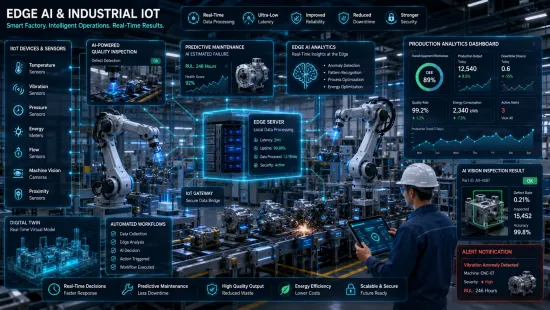
Edge Computing Solutions Across Industries
Modern edge computing solutions are transforming nearly every industry by enabling smarter, faster, and more efficient operations.
Healthcare
Hospitals use edge computing for:
- Remote patient monitoring
- AI-assisted medical imaging
- Smart wearable devices
- Emergency response systems
Processing patient information locally improves response times while protecting sensitive healthcare data.
Manufacturing
Industrial facilities benefit from:
- Predictive maintenance
- Smart robotics
- Automated quality inspection
- Industrial IoT monitoring
These capabilities reduce equipment downtime and improve production efficiency.
Retail
Retail businesses use edge based system to improve customer experiences through:
- Smart checkout systems
- Personalized digital signage
- Inventory tracking
- AI-powered customer analytics
Real-time insights help retailers optimize inventory while enhancing customer satisfaction.
Transportation
Connected vehicles rely heavily on edge AI to process massive amounts of sensor data instantly.
Applications include:
- Collision avoidance
- Traffic optimization
- Fleet monitoring
- Autonomous driving support
Fast decision-making is essential for passenger safety.
Edge Computing Is Powering the Next Generation of AI
While many people associate AI with cloud computing, the future is increasingly shifting toward AI at the edge.
Modern devices can now run AI models locally without constantly depending on cloud servers. Smartphones, surveillance cameras, drones, industrial robots, and wearable devices are becoming more intelligent by processing data directly on-device.
This shift enables:
- Faster AI predictions
- Better privacy
- Reduced internet dependency
- Lower operational costs
- Improved user experiences
As AI hardware continues to advance, edge computing will become a foundational technology for intelligent automation across industries.
Edge Computing Vs Cloud Computing
Many people assume that edge solutions will replace cloud computing. In reality, the two technologies work together to create a more efficient and scalable IT infrastructure.
Cloud computing excels at storing large amounts of data, running complex analytics, and training AI models. On the other hand, it focuses on processing data closer to where it is generated, enabling faster responses and reduced latency.
| Feature | Edge Computing | Cloud Computing |
|---|---|---|
| Data Processing | Near the data source | Centralized data centers |
| Speed | Very Fast | Moderate |
| Latency | Low | Higher |
| Internet Dependency | Low | High |
| Best For | Real-time applications | Data storage and analytics |
| Scalability | Localized | Global |
Businesses often use a hybrid approach where real-time data processing occurs at the edge, while long-term storage and advanced analytics remain in the cloud. This combination provides the best balance of speed, scalability, and efficiency.
Best Practices for Implementing Edge Computing
Successfully adopting this technology requires careful planning and the right infrastructure. Businesses should focus on scalability, security, and efficient data management to maximize long-term benefits.
Identify Real-Time Workloads
Every app does not need edge computing. Companies must first focus on the apps where instant processing is necessary, such as:
- Industrial Automation
- Video Analytics
- Smart Surveillance
- Self-Driving Cars
- Monitoring IoT
- Customer Experience via Artificial Intelligence
Analyzing application needs is critical for businesses to understand the most valuable areas of edge solutions.
Strengthen Edge Security
Since edge devices in networks are spread across various locations, there needs to be proper cybersecurity.
Some recommended approaches are:
- Secure data in transit and at rest.
- Practice Zero Trust security.
- Employ multi-factor authentication.
- Ensure firmware/software updates.
- Constantly monitor connected devices.
This ensures that there is protection for sensitive corporate information.
Integrate Edge with Cloud Infrastructure
The most effective deployments combine edge and cloud computing rather than treating them as competing technologies.
Organizations should:
- Process time-sensitive data locally.
- Store historical data in the cloud.
- Train AI models in centralized environments.
- Synchronize edge devices with cloud platforms.
This integrated approach supports scalability while maintaining real-time performance.
Challenges of Edge Computing
Although its benefits are significant, organizations should also understand the challenges associated with implementation.
Infrastructure Costs
Deploying edge servers, gateways, and intelligent devices requires an initial investment. Businesses must evaluate hardware, networking, and maintenance costs before implementation.
Device Management
Managing thousands of distributed devices can become complex.
Organizations need centralized monitoring tools to:
- Track device health.
- Perform software updates.
- Detect failures.
- Ensure security compliance.
Effective lifecycle management is essential for long-term success.
Data Consistency
Processing information across multiple locations may lead to synchronization challenges if systems are not properly integrated.
Businesses should implement reliable synchronization mechanisms to ensure consistent data between edge locations and cloud platforms.
Future Trends in Edge Computing
The future of edge-based systems for business is closely connected with advancements in AI, IoT, and next-generation connectivity.
Edge AI Is Expanding Rapidly
Modern devices are becoming capable of running AI models directly on the device without relying on constant cloud connectivity.
Edge AI is enabling:
- Intelligent surveillance systems
- Smart manufacturing
- Predictive maintenance
- Autonomous drones
- Healthcare diagnostics
- Personalized retail experiences
As AI hardware becomes more efficient, local intelligence will become increasingly common.
5G and Intelligent Edge
The rollout of 5G networks is accelerating the adoption of the intelligent edge by enabling:
- Ultra-low latency
- Faster communication between devices
- Reliable IoT connectivity
- High-speed data transfer
- Large-scale smart city deployments
Together, 5G and distributed computing create a powerful foundation for future digital services.
Growth of Industrial IoT
Manufacturing, logistics, and energy sectors continue expanding their use of industrial IoT.
Factories now deploy connected sensors that monitor equipment health, predict failures, optimize production, and reduce downtime using real-time insights generated at the edge.
This trend is expected to continue as organizations pursue greater operational efficiency and automation
Why Edge Computing Will Become a Business Necessity?
Over the next decade, organizations will generate exponentially more data from connected devices, AI applications, autonomous systems, and IoT ecosystems.
Sending every piece of data to centralized cloud servers will become increasingly inefficient.
Businesses that invest in edge solutions today position themselves to:
- Deliver faster digital services.
- Improve customer experiences.
- Reduce operational costs.
- Enhance cybersecurity.
- Support AI-driven innovation.
- Scale connected device ecosystems efficiently.
Rather than viewing edge solutions as an emerging technology, organizations should recognize it as a strategic investment that enables long-term digital transformation and competitive advantage.
Conclusion
As more businesses adopt digital transformation, this is emerging as one of the most important technologies in order to perform computation and data storage efficiently and fastly. The results we get in reduced latency, fast decision-making, and improved security.
Whatever application you consider from Industrial IoT, AI at edge, self-driving cars, smart healthcare or intelligent retail; It will help you make your business more reactive to real-time challenges.
Combining edge computing with cloud computing infrastructure will enable your organization to cope with the ever-increasing volumes of data. As Edge AI, 5G, and intelligent devices continue evolving, your adoption for business today will position you for success in the future.
Read More Blogs
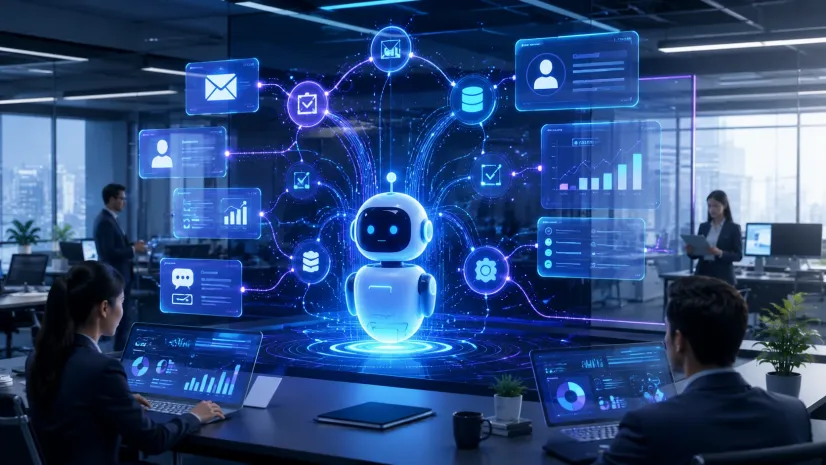
How LangChain AI Agents Help Businesses Complete Tasks Automatically?
AI Agents vs Traditional Marketing Automation: Which One Is Better?
Essential Features for Modern E-Commerce Websites
Frequently Asked Questions About Edge Computing
1. Define edge computing in your own words.
It refers to a type of distributed computing that handles data close to where the data is being produced, which helps to make the process more efficient than transferring all data to the cloud.
2. List the main advantages of this technology.
The main advantages of using this technology include low latency, fast data processing, better security, cheaper bandwidth, increased reliability, and suitability for AI and IoT applications.
3. Compare edge computing and cloud computing.
It involves local data handling and processing, cloud computing implies transferring data to the central data center.
4. In what sectors are edge computing solutions utilized?
The sectors that utilize this solution include but are not limited to health care, manufacturing, retail, transportations, telecommunications, energy, and intelligent city infrastructures.
5. Why is edge computing vital for business?
This is for business helps companies operate data faster, enhance their customers' experiences, cut costs on operations, increase security, and apply innovative technologies like AI, industrial Internet of Things, and 5G.
Shiv Shakti Softech
We are a team of passionate digital experts dedicated to helping businesses grow online through innovative web design, SEO, and marketing strategies.
Work with usNeed Expert Help?
Ready to leverage these strategies for your business? Let's talk about your project.
GET IN TOUCH